
How to Need Game Illustration for Build the Gaming World
Table of Contents
Every game has a gaming world the player wants to discover. But creating a world that would be realistic enough to attract players demands not only an interesting plot or mechanics. When characters are inappropriate, or environments lack dynamics and when all the visual design is inconsistent, gamers may face some trouble while exploring the world you have created.
Now your goal is to transform your vision into artwork that will catch gamers’ attention and inspire them to further exploration. But how can one create a world worth discovering? Let’s figure it out together.
Why is Illustration Important in Game Design?
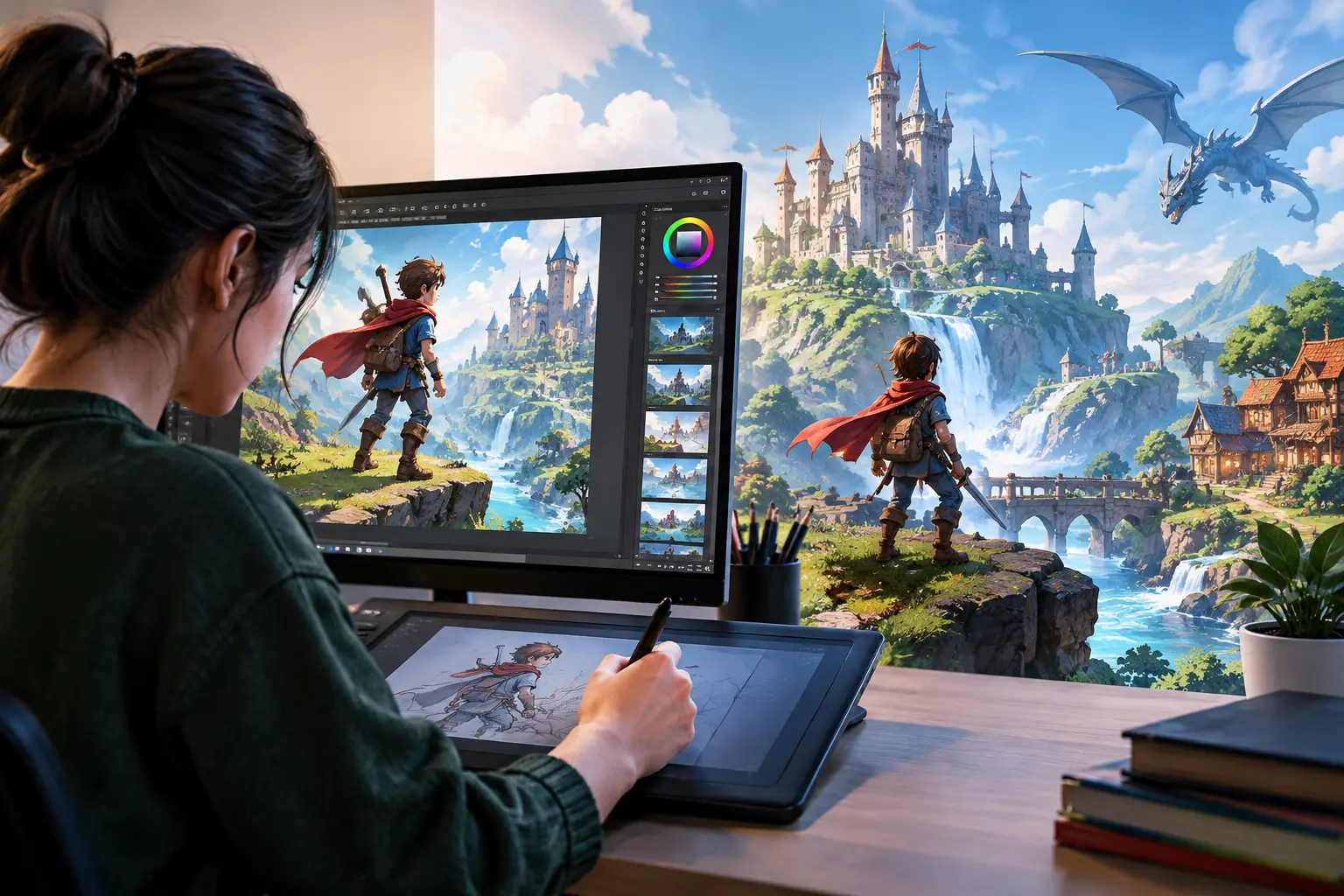
With illustrations, you will be able to give visual form to your game concept. Before the creation of the world, the artists used visual references and concept art to develop the visual style, from the clothing of the characters to far cities’ layouts.
The proper game illustration provides your development team with a clear idea of what the final product will look like. As a result, the designers, artists and developers of your project will know what the end product should be.
The need for this comes from the fact that most players form an opinion about the game by just seeing its graphics before having even learnt anything about the mechanics of the game. The colours, characters, environment, and graphics design show whether the game will be funny, mysterious, scary, or adventurous.
How Can You Make a Gaming World Feel Alive?
The creation of a realistic gaming environment goes beyond creating aesthetically pleasing backgrounds. There must be a sense that there is life outside the gamers’ range of sight. It is not just about making a gaming environment look nice. It must be such that it is apparent that there is life outside the gamers’ line of sight.
Create the Environment That Tells the Story
Consider what the players should realise when entering a new environment. For example, a destroyed fortress will tell about a previous battle, while a lively market will show how the people trade.
Useful environmental details include:
- Architecture: Buildings and structures that demonstrate the world’s culture, history, and natural resources.
- Lighting: Warm sunlight for friendly locations or cool lighting for secluded, eerie locales.
- Objects: Damaged weapons, discarded tools, handwritten messages, and other hints regarding the occurrences of the past.
- Natural features: Forests, rivers, mountains, and foreign plants that create uniqueness for the place.
Their inclusion in the game will aid the players in exploring the environment rather than running fast through every level. It will also help in communicating the message without explaining all of it.
Maintaining Visual Style Consistency
Even though the environment can be quite detailed, if it contains art that doesn’t fit in with the overall game, it would still look strange. Realistic city, cartoon characters, and highly imaginative creatures might not blend well.
Make a visual guide for your game before the development process starts. This guide will determine your game’s colour scheme, lighting effects, character dimensions, textures, and architectural style.
This visual guide will be especially helpful if multiple artists develop various locations in the game. It allows artists to create freely without having your final game look like an array of designs.
Which Types of Illustrations Does Your Game Need?
Each kind of illustration has its role in developing a game. When you know the type of illustration your game requires, you can allocate resources effectively and not spend your time creating unnecessary images.
The following are the types of artwork that games use:
- Concept Art: The initial drawings that illustrate what the game looks like in terms of location, characters, and other elements.
- Character illustration: The design of a character’s appearance, clothes, behaviour, personality, and distinguishing features.
- Environment art: The design of landscapes, buildings, interiors, and all locations which the player is expected to visit.
- Prop illustration: The design of items, weapons, tools, objects, vehicles, and all interactive items.
- Promotional artwork: Images which are meant to be used in advertising, web pages, social media and pages in game stores.
- Art for the story: Illustrations for dialogues, action scenes, maps and other events to explain the history of the game.
You do not need all types right from the start. There are some indie games that require only a few concept illustrations and designs for some characters, while some large RPG games require a lot of artwork because there are a lot of places in the game world.
First, you should create a set of images for creative decisions. Then, when you understand the direction, you may increase your collection of images.
How Do You Choose the Right Art Style?
Your art style should suit the story you want to tell and the people you want to reach. It also needs to work within your team’s budget, technical resources, and production schedule.
Consider these common approaches:
| Art style | Best suited for |
| Realistic | Historical adventures, military games, and lifelike simulations |
| Cartoon | Family games, humorous stories, and colourful platformers |
| Fantasy | Magical kingdoms, mythical creatures, and imaginative adventures |
| Pixel art | Retro-inspired games and projects with deliberately simplified visuals |
| Stylised 3D | Distinctive worlds that combine depth with an artistic appearance |
Test your style by experimenting with a part of the game first. Create a character, an environment, and a few objects for testing. In this way, you will have the opportunity to check the compatibility of your style and learn about its implementation possibilities.
Why Should You Work with a Professional Illustrator?
Cooperation with a professional illustrator is a wonderful opportunity for you to visualise your idea through pictures and express your thoughts correctly. If you have already developed your idea, but cannot describe in words the appearance of your characters, setting, etc., this option would be especially useful for you.
However, when choosing an artist, pay attention to the work he has done, and not only to the beautiful illustrations in his portfolio. If the artist specialises in creating atmosphere, he might suit you better for creating a dark fantasy game than the artist who creates mostly funny characters for kids’ books.
Searching for a book illustrator UK can be another way to find an artist with the necessary experience. Yet, keep in mind that illustration for books and video games is different.
Before hiring anyone, discuss:
- The visual direction and intended audience.
- The number and type of illustrations required.
- File formats, dimensions, and revision limits.
- Deadlines, payment terms, and usage rights.
- Whether the piece needs to be adapted for each medium.
An agreement eliminates any confusion about what the final product is supposed to look like.
How Can You Use Game Artwork Beyond the Game?
Images you have made will not only help you play the game but can be helpful for the introduction of the game, its promotion and the maintenance of the same image in all your advertising materials.
It is important to think about where and how you will use the artwork before ordering it. Character portraits may be suitable for your website, while landscapes can serve as good promotional banners. It is possible to use certain pictures in the form of posters, merchandise products, collector’s editions, or in a book telling the story of your game.
If you are going to include the novel or a story in your project, a book cover maker will enable you to create a cover page for the novel reflecting the spirit of the game. The cover page should convey the mood of the story without being similar to the promotional pictures of your game.
What Do Industry Figures Tell You About Visual Competition?
Because the scope of the gaming industry is quite significant, the need to create a unique visual identity requires planning. According to the Newzoo Global Games Market Report 2024, there would be around 3.42 billion gamers in the world in 2024, which would increase to 3.76 billion gamers in 2027.
Such statistics relate to the overall gaming population and not necessarily to the number of players your specific game will attract. However, these numbers do show how many games compete with one another. Therefore, the lesson to be learnt from the above statistics is clear: artwork must be able to express the uniqueness of your game.
Readers Usually Ask
Is it required to develop unique game illustrations for each game?
No, there can be cases when some games will be fine with generic visuals, but adventure games need to have unique and detailed art to support the story. The needs will depend on the game type and budget you set aside.
When should the process of game illustration start during game development?
It is recommended to start the creation of illustrations from the conception phase of game development.
How expensive is the process of creating game illustrations?
It depends on several factors, such as the artist’s experience, the complexity of the art, the number of illustrations needed, etc. You can request a quotation based on your brief instead of having one common price.
Can the game illustrations be used for marketing purposes?
Sure, if you get the agreement in advance.
In Conclusion!
In order to create a game world that is worth experiencing, there has to be a vision and proper use of artwork that will make it possible. This includes everything from characters and the environment to colours and even the little details, which should all be chosen depending on how they would help in improving the story. Consider your illustrational needs right from the beginning and choose a suitable art style depending on your audience. It is not necessary to develop everything at once, but focus on developing the visual elements first before going further with development!

My writing for ChildrenIllustration.co.uk delves into the area of creative book art for young readers. I’m interested in how pictures contribute to the development of characters, scenes, and emotions in a tale. My writings contain concepts that motivate writers, publishers, and artists alike. This place is dedicated to telling visually compelling stories.