
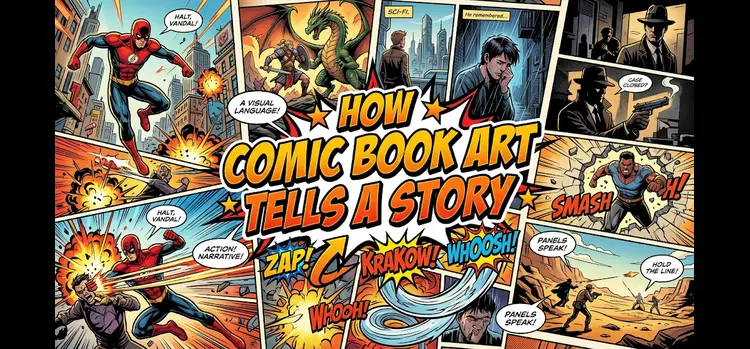
How Comic Book Art Tells a Story? The Visual Story Behind Every Panel
Table of Contents
Let’s be honest! We all have loved comics since childhood, didn’t we? But have you ever wondered why we prefer comic books over traditional books? Well, one of the primary reasons is the unique storytelling experience of comics.
The way comic books blend written narrative with cinematic visuals is indeed praiseworthy. And this is why they have been head over heels for these comics since the late 1930s.
But do you know how comic book art actually tells a story? No worries if you don’t know it because we are here to tell you!
So what are we waiting for? Let’s dive into it!
What Is the Psychology of Panel Layout in Comics?
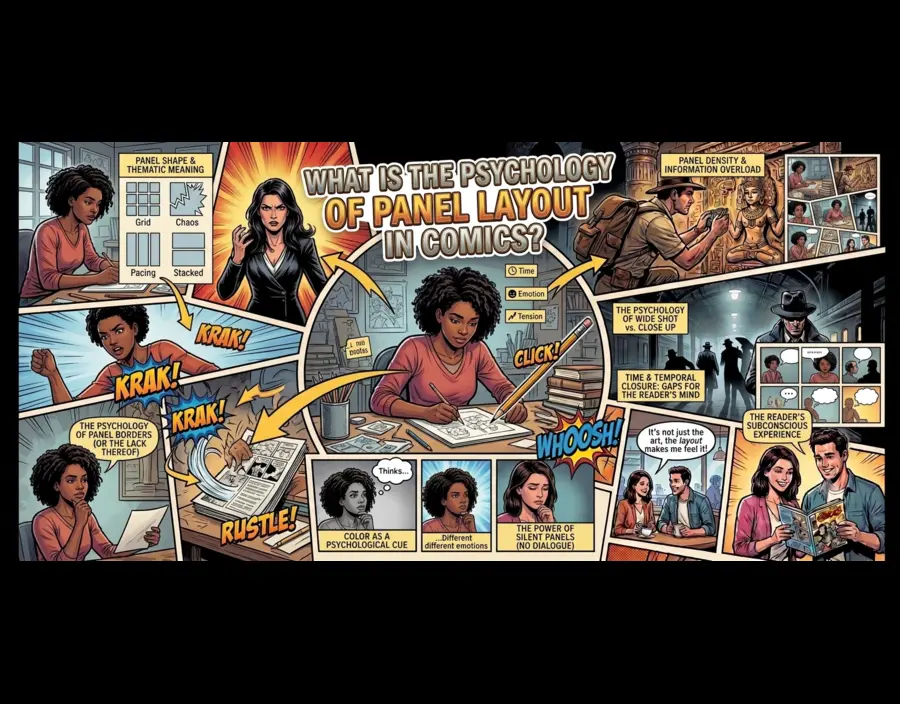
We’ll begin our discussion by understanding the psychology of panel layout.
The psychology of panel layout relies on manipulating the reader’s perception not only of time but also of rhythm.
But why do panel layouts even matter in comics? Well, this is because comic pages are viewed all at once but read sequentially. And this is why creators take advantage of visual space to subconsciously dictate the pacing of an emotional beat or an action sequence.
The comic illustrators also make sure that their illustrations have space between them, depending on the pace of the scene. Isn’t that amazing?
The following are the psychological impacts of panel layout on several key structural elements:
1. The Gutter
You might be wondering what a gutter is doing here, right? Hold your horses, because we’re not talking about the gutter that carries away water, debris, or other materials. Then what are we even discussing?
Basically, the white space between the panels is actually called a gutter in comics. And it represents the passage of time or a spatial shift.
But who even came up with this idea? Well, the concept of the gutter was formalised as well as popularised by cartoonist and theorist Scott McCloud in his foundational 1993 book.
2. The Closure
And what is a closure in a comic? Actually, when readers look at the next panel, their brains actively fill in the missing action or events that happened between the frames. And this cognitive participation is basically known as closure.
And genuinely, it is the primary engine that makes reading comics an interactive psychological experience.
3. Panel Size and Time Perception
You may not be aware of this, but the size of a panel directly correlates to the amount of narrative time that passes. Or how long a reader’s brain subconsciously dwells on that moment.
In simpler words, it is a vital storytelling tool that dictates the pacing of time and the importance of a moment within the story.
❖ Smaller Panels:
These smaller panels basically show rapid visual scanning. Your brain actually processes a sequence of small panels quickly. And this creates a feeling of fast-paced action or a rush of consecutive dialogue.
❖ Larger Panels:
Larger panels, on the flip side, subconsciously signal the importance of the scene. They also show a pregnant pause. But what is even a pregnant pause? It is actually a meaningful silence in speech that is “pregnant” (or full) not only with anticipation and tension but also with unspoken meaning.
Besides, these larger panels basically force the reader to slow down and absorb the atmosphere or emotional weight of a scene.
❖ Splash Pages:
Now, what is a splash page? You don’t know? It’s okay. We’ll help you understand it! It’s actually a massive panel that takes up an entire page. It can also span across two pages as a double-page spread.
It usually contains a single, dramatic illustration with no other panels on that page.
How Comic Writers Put Visual Narrative into Practice?
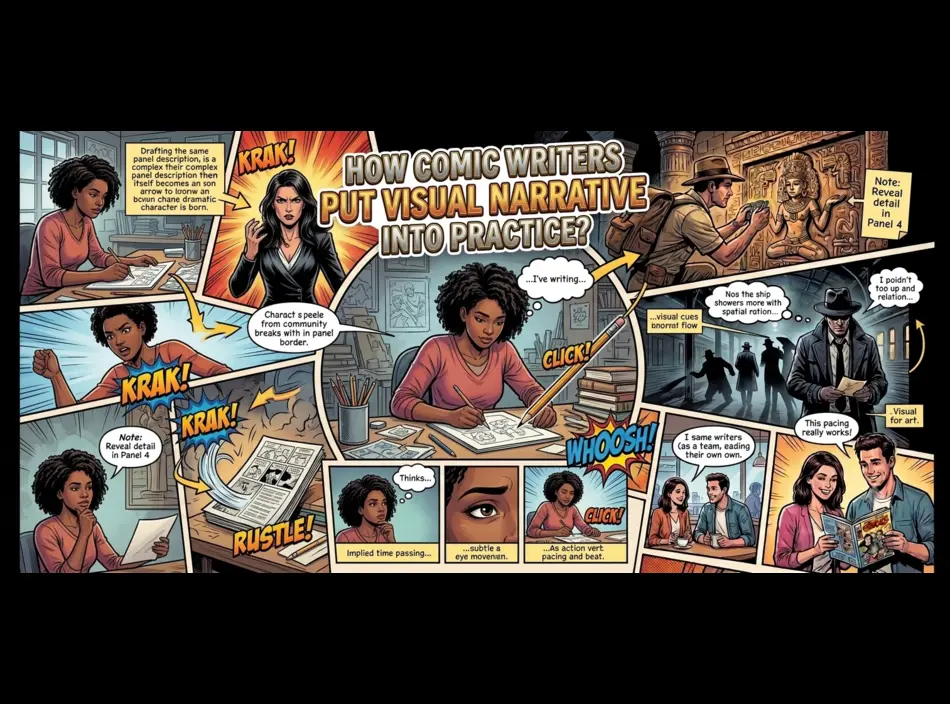
But the question is, how do comic writers actually put visual narrative into practice?
If you’ve ever read a comic, you must know that Western comics are read following a “Z-path” (left-to-right, top-to-bottom). Artists basically manipulate this natural flow. This helps them influence the pacing.
But how do they even do this?
1. Eye Lines
Firstly, these creators frequently use not only character eye lines but also character positioning and directional weapons to guide the reader’s eyes to the next panel physically. And this helps them prevent readers from skipping key story beats.
2. Sound Effects (SFX)
Apart from this, writers also use onomatopoeia, such as KRAK! or THOOM, to act as visual punctuation. This helps them direct the reader’s eye across the page and mimics the impact of the action.
3. Body Language and Facial Expressions
Not only this, but muscle tension, posture, and facial expressions are also used in the comics. These characteristics help readers instantly understand how a character is really feeling.
This also allows the art to communicate complex emotions without needing any dialogue.
4. Blocking
However, writers often place a long, vertical panel on the right side of the page that spans multiple rows. This basically breaks the standard Z-path. And it forces the reader’s eye to move vertically instead. This creates suspense or an interruption.
5. Colour Palette
Let’s be real! Colours do set the mood and atmosphere. Warm and bright colours convey joy or heroism. On the other hand, cool and muted tones like blues and greys signal not only tension and sadness but also a dangerous setting.
However, many comic writers often struggle with illustrations. As a result, they seek Illustration Services from professionals.
Most Asked Questions
How do comics actually tell a story?
Ans. Comics basically tell a story by combining text and images into sequential art. Also, they use a visual language where the reader actively participates in connecting the pieces.
How does a comic book differ from a storybook?
Ans. A comic book actually tells a story through sequential art and speech bubbles. And a storybook relies mainly on written text with illustrations.
Do comic books even have any benefits?
Ans. Yes, comic books do offer several benefits. These include not only cognitive and educational benefits. Also, they not only actively build reading comprehension but also improve vocabulary and boost critical thinking by forcing the brain to process both visual and textual information simultaneously.
To Conclude
All in all, comic books have been popular among people of all ages for decades. One of the reasons for this widespread acclaim is its visually appealing and engaging art. Also, they teach your brain to process multiple layers of information at once by merging text and visuals.
On top of that, these comic books use the psychology of panel layout. This helps them narrate an exceptional story with very few dialogues. Besides that, illustrations play a crucial part in these comics. The eye lines, body language, facial expressions, sound effects, and colour palettes help the writer visually narrate their story.

My writing for ChildrenIllustration.co.uk delves into the area of creative book art for young readers. I’m interested in how pictures contribute to the development of characters, scenes, and emotions in a tale. My writings contain concepts that motivate writers, publishers, and artists alike. This place is dedicated to telling visually compelling stories.